
OVERVIEW
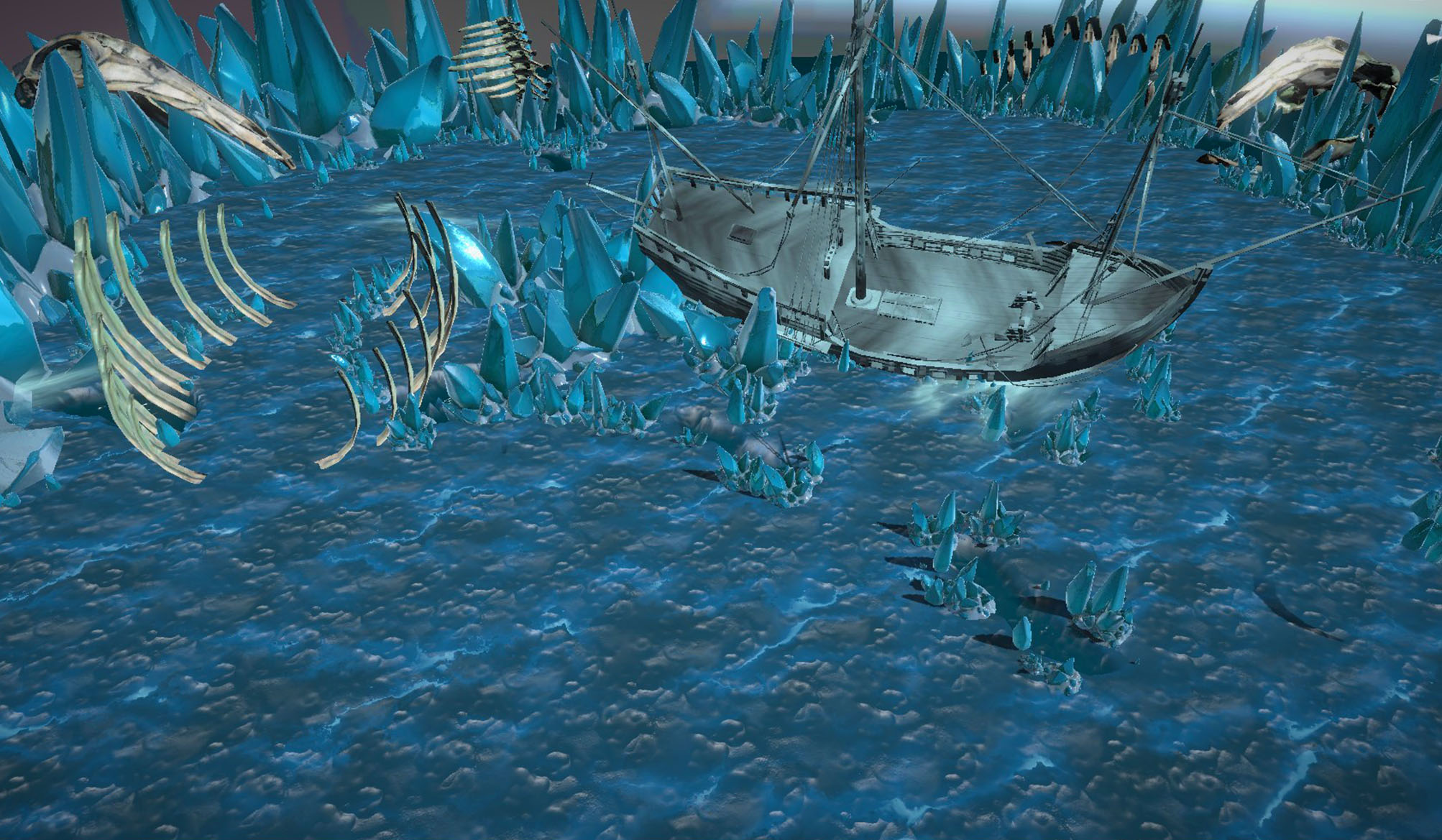
Ice Ship is a compact event map set on a drifting sheet of ice surrounding the wreck of the Pirate Queen‘s ship.
Players explore the island while fighting and looting groups of undead pirates until the Pirate Queen appears in a dedicated boss arena. The environment uses sculpted terrain, wreckage, animal remains, and ice formations to guide movement while telling the story of a crew stranded far from land.
DESIGN GOALS
- Create a compact map that encouraged exploration
Build interconnected combat spaces that allowed players to circulate through the environment while completing the event’s kill and loot requirements. - Reserve a dedicated space for the final encounter
Keep a large section of the map relatively open so the Pirate Queen’s area-of-effect abilities had sufficient room to function without compromising the rest of the layout. - Use the environment to communicate the event’s story
Reinforce the fate of the stranded crew through the shipwreck, skeletal remains, wildlife, and other environmental details rather than relying solely on written narrative. - Maintain pressure while players explored
Combine regular enemies, elites, and an environmental hazard to keep players engaged as they moved between combat areas.
DESIGN PROCESS
The map was built on a sculpted terrain mesh rather than a simple flat surface. Its uneven elevation, depressions, and irregular outer edges gave the island a more natural foundation, but also required the playable spaces and routes to account for the existing terrain. I began with a greybox to establish the major combat areas, connections between them, the inaccessible ship centerpiece, and the open space reserved for the Pirate Queen encounter.
The ship acted as the map’s primary visual landmark while also providing an inaccessible area where I could place one of the game’s new environmental hazards. Hidden from players and impossible to target, the hazard periodically targeted an individual player with falling ice. The attack was deliberately easy to avoid, but being hit applied a Slow, adding occasional positional pressure while players fought and explored without introducing another conventional enemy.
As the environment developed, I increasingly used decorative elements as functional parts of the layout. Large skeletal remains reinforced the story of the stranded crew while also creating landmarks and boundaries, including a passage built through the ribcage of a large creature. Other details were deliberately left unexplained, such as a mammoth skull impaled on a large ice formation, suggesting that starvation may not have been the only danger faced by the crew.


ITERATION
The initial environment relied heavily on the terrain, shipwreck, and ice formations, but early versions felt too sparse. I introduced the remains of large animals throughout the island, which helped fill the environment while also strengthening the narrative surrounding the stranded crew. Some of these elements were subsequently incorporated into the playable layout rather than remaining purely decorative.
I continued the environment pass by adding additional ice crystal formations throughout the map, including beyond the playable boundaries. Although these objects had no gameplay function, extending visible details outside the accessible space helped the island feel less artificially contained and created a stronger backdrop when viewed from within the level.

IMPLEMENTATION & PRELIMINARY TESTS
Testing revealed that the sculpted terrain mesh was not receiving shadows correctly, leaving characters and environmental objects visually disconnected from the ground. Because the issue originated from the terrain asset itself, simply adjusting the level lighting did not resolve the problem.
I worked around the limitation by placing an invisible quad immediately above the terrain surface and configuring it to receive shadows. This preserved the appearance and irregular shape of the original terrain while restoring the expected grounding shadows across the playable area, avoiding the need to replace or substantially modify the underlying mesh.
UNIT POSITIONING
Enemy placement was designed to support both the event’s combat loop and the story of the stranded crew. Large groups of skeleton pirates were concentrated around the wrecked ship, making the central landmark the most heavily populated part of the map and reinforcing the idea that the undead crew remained gathered around their vessel.
Polar bears were instead placed toward the outer edges of the island, particularly around treasure and supply locations. Narratively, these areas represented places where the crew had stored food and other resources, eventually attracting the bears. From a gameplay perspective, this placed elite enemies away from the main concentrations of pirates and gave players a reason to explore the perimeter.
Chests and crates from the ship were distributed throughout these spaces as additional points of interest. Besides supporting the shipwreck theme, they provided practical rewards such as Gold and healing, making exploration useful throughout the event rather than purely decorative.

TAKEAWAYS
Environmental storytelling works best when it also supports gameplay
The skeletal remains, shipwreck debris, and supply areas helped communicate what happened to the crew while also defining routes, landmarks, encounter spaces, and reward locations.
Enemy placement can reinforce the logic of an environment
Concentrating undead pirates around their ship and bears around abandoned food and supplies made encounters feel connected to the setting rather than arbitrarily distributed across the map.
Decorative elements can significantly improve the perceived scale of a small level
Extending ice formations beyond the playable boundaries and adding large environmental features helped the compact map feel like part of a larger, less artificial environment.
Technical problems do not always require rebuilding the underlying asset
The terrain shadow issue was resolved with a simple additional shadow-receiving surface, preserving the sculpted terrain while avoiding unnecessary changes to the original mesh.
Small maps benefit from multiple forms of spatial pressure
Regular enemy groups, perimeter elites, the falling-ice hazard, and a dedicated boss arena created different reasons for players to move without requiring a complex objective structure.